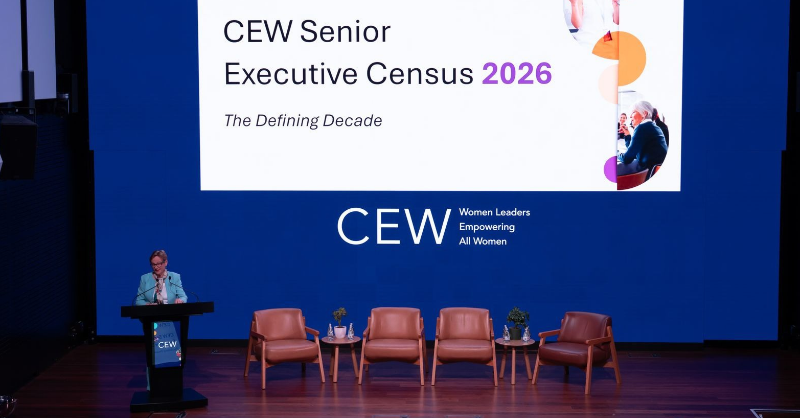
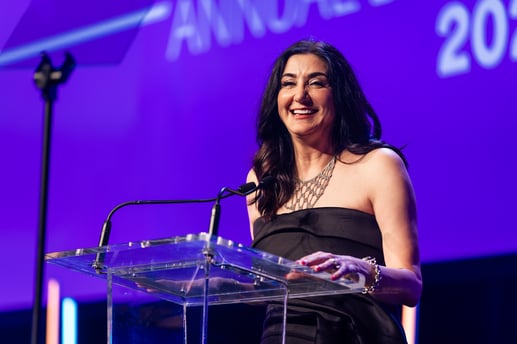
In 2026, the Chief Executive Women Annual Dinners were held in Melbourne, Perth, Brisbane and Sydney. CEW, CEO Lisa Annese AM, reflected on CEW in advancing gender equity and developing women’s leadership in Australia, celebrating its impact through scholarships, programs and member contributions.
You can read the full written version of Lisa Annese AM address below.
Good evening, everyone. Thank you so much for joining us tonight for the first in our series of national dinners across the country.
It is extraordinary to be in this room with you all - members, partners and supporters of CEW - united in a shared vision that gender equity will deliver a stronger, more resilient nation and economy.
This purpose has driven CEW for over four decades. It has helped us shift the national conversation on women's leadership, secure public policy outcomes that have materially improved women's workforce participation and build one of the most significant women's leadership scholarship and development programs in the country. There is still so much more to be done. But I want to acknowledge something first. The progress we have made, and the progress we will continue to make, would not be possible without the people in this room.
Our members. You are the heart of this organisation. Women who carry CEW's mission into your own workplaces, your own boardrooms, your own communities. I particularly want to acknowledge our founders, past presidents, our current President, Board and Committee members who are here with us tonight.
Special thanks to our sponsors and partners, whose generosity funds the scholarships and programs that change women's lives.
Helen shared with you tonight what a CEW scholarship meant in her life. And her story is one of hundreds. Our scholarship program now creates opportunity for more than 30 women each year, in partnership with some of the world’s leading business schools and institutions. In addition, CEWs Leaders Program and Executive Leaders Program meet women at the career moments where the right support can change everything. The women who come through these programs go on to lead in ways that reshape the organisations and communities around them.
Let me give you a sense of what that looks like. Kate Farrar received a CEW scholarship to attend INSEAD in 2015. Today she is the CEO of Brighter Super, having grown the fund from $10 billion to $30 billion. Lesley Nelson, a proud Noongar woman, received a Roberta Sykes scholarship to attend Harvard Kennedy School in 2018. Today she is the CEO of the Southwest Aboriginal Medical Service. And last year, Lesley became a CEW member. From scholarship recipient to the leadership table. That is what this investment produces.
These are women were already talented, already driven. What CEW gave them was the backing, the network, and the belief that the next step was theirs to take. And the impact does not end with them. It extends through every person they lead, every decision they shape, every door they open for the woman behind them.
But it is important to be clear-eyed about the challenge in front of us.
We know from last year's CEW Senior Executive Census that 80 per cent of CEO pipeline roles are still held by men. Ninety per cent of CEOs are men. And 17 ASX 300 companies have no women in their leadership teams at all. This is not about an absence of talent or merit. The barriers are embedded in structural settings, in corporate cultures, in careers that don’t reflect the reality of womens’ lived experiences, and it is in how we define and reward leadership.
The broader landscape is also cause for concern. Recent research from the Global Institute for Women's Leadership found that young men are now nearly twice as likely as older generations to hold traditional views on gender roles. The assumption that each generation will naturally be more supportive of gender equity than the last is no longer holding. And globally, companies and governments that had committed to advancing gender equality are pulling back. Australia is not immune to these pressures.
That is why CEW's work is so urgent. We are focused on four priority areas, informed by consultation with our membership: to accelerate women's leadership, strengthen women's economic security, work to end violence against women, and to place care at the centre of the economy. We have called on businesses to set gender balance targets, invest in diverse leadership pipelines, build flexible, respectful, and inclusive workplaces, and rethink the leadership blueprint. We have called on government to invest in women's leadership, economic security and safety, to reform the tax and transfer settings that penalise women's workforce participation, and to invest in the care economy as critical economic infrastructure.
Leveraging women's leadership and workforce participation is one of the most powerful levers we have to build a stronger, more productive, and resilient Australia. At a time when our nation is facing critical economic and workforce challenges, women's full participation is not optional.
The theme of this year's dinner is "Create." And I think it speaks to something true about what this community is building together. Through our programs, we are creating the next generation of women leaders. Through our advocacy and research, we are creating the conditions for a more gender equal Australia. And through the collective effort of everyone in this room, we are creating something that will outlast all of us: a different standard for what leadership in this country looks like.
CEW will continue on this path, with your backing, for as long as it takes.
Thank you. Enjoy the evening.
From the blog