
The Defining Decade: A decade of change and the choices that will shape the next
The tenth CEW Senior Executive Census examines who holds power across Australia's leading listed companies, where the pathway to CEO is narrowing and what business leaders must do to accelerate change.
The findings are clear: progress is stalling, pushback is rising, and executive leadership still does not reflect the diversity of Australia.
ASX Key Findings
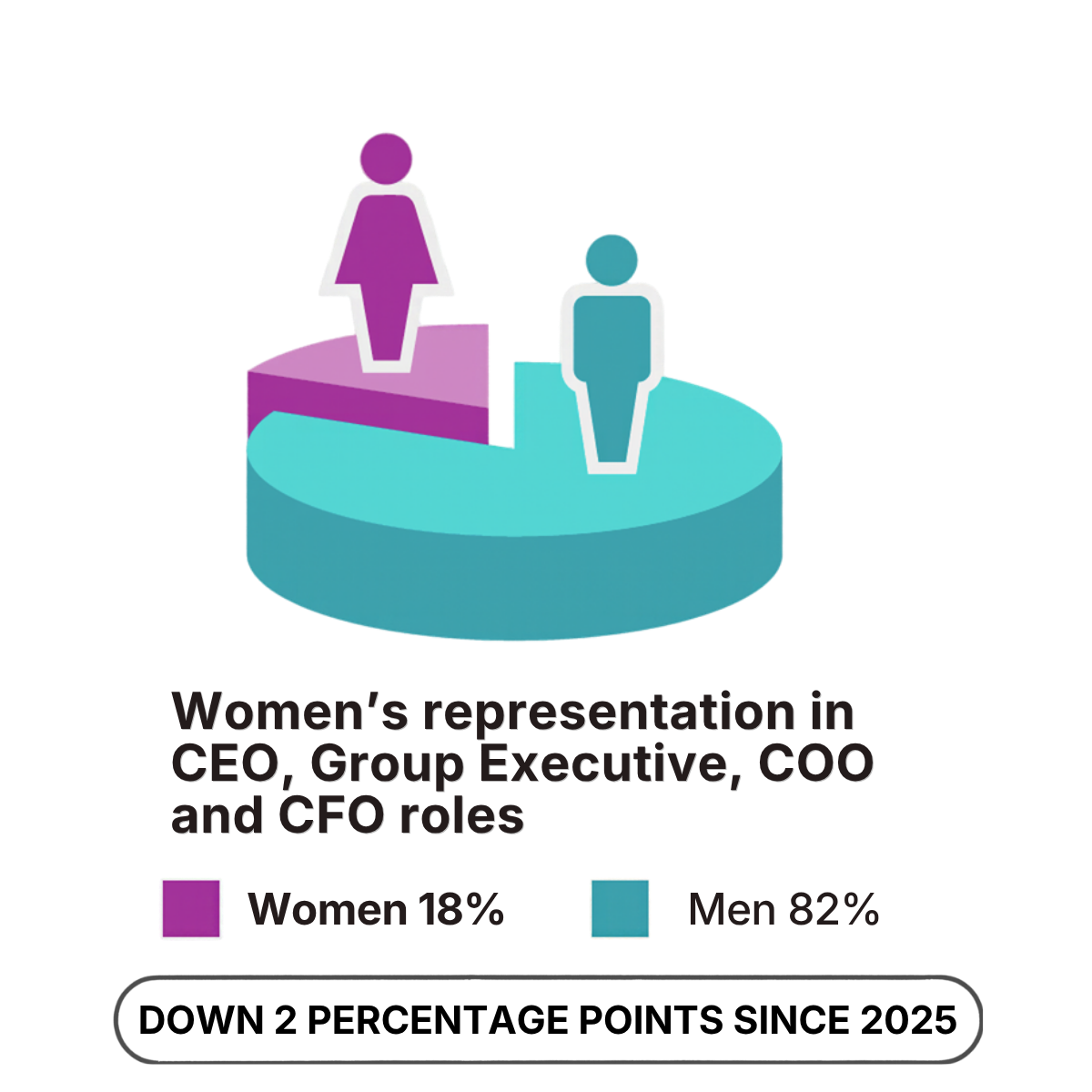
Sustained attention has increased women's representation across Executive Leadership Teams, CEO pipeline roles and CEO positions. However, momentum has stalled since 2023.




Corporate Australia must consider what kind of society it wants to be part of, and what role it is prepared to play in shaping it.
Rising Pushback in Australian Workplaces
To understand the climate behind the 2026 figures, we asked CEW members for the first time whether support for gender equity in their organisations had grown or diminished over the past year.

Response from CEW member survey
Over the past 12 months, to what extent has support or opposition for gender equity changed in the spaces where you work and lead (e.g. Boardrooms, workplaces, where you do business)?

While 54% of CEW members surveyed reported "no change", this should not be interpreted as business as usual. Senior women leaders used "no change" to describe a range of experiences, from sustained commitment through to stalled progress and declining organisational ambition.


I have observed direct verbal opposition to gender equity becoming more common in the boardroom and workplace. At times, it feels as though the 'boys' club' mentality has regained confidence, with some people feeling increasingly emboldened to dismiss or openly undermine gender equity efforts.
We are not talking about it anymore, and there are no resources or investment allocated to any such initiatives — so there is no open opposition, just lack of interest.
Take Action: Five Gender Balance Accelerators
Set and publish 40:40:20 gender targets for executive teams, CEO pipelines and succession pools, linked to executive remuneration.
- 40:40:20 = at least 40% women, at least 40% men and 20% of any gender.
- Embed executive ownership of gender equality targets and establish mechanisms for regular board oversight.
- Link progress against targets to executive remuneration, including performance measures and incentive payments.
Build gender-balanced CEO pipelines at every stage of succession planning, with women moved deliberately into profit and loss roles.
- Aim for gender balance at every stage of succession planning, from high-potential talent pools and development programs to ELT and CEO shortlists.
- Create rotations, secondments and acting opportunities that move women into roles with profit and loss (P&L) responsibility, building operational and commercial experience.
- Make senior leaders responsible for sponsoring women into influential networks, high visibility assignments and promotion opportunities.
Address pushback and backlash.
- Understand gender equality as a governance, culture, workforce and performance opportunity.
- Address pushback and backlash publicly and inside the organisation.
- Reaffirm targets and maintain investment when commitments are challenged, or business conditions change.
- Speak up against backlash, challenge misinformation and protect employees who speak up about resistance and inequity.
Create flexible, safe, inclusive workplaces.
- Make flexible work accessible and visible across levels, job functions and location without career penalties.
- Review pay, promotion, development opportunities and employee departures for gender disparities, including how gender intersects with other forms of disadvantage.
- Build safe, respectful and inclusive workplaces, trusted reporting pathways and clear accountability for discrimination and sexual harassment.
Broaden the leadership blueprint: challenge definitions of CEO readiness that privilege a single career pathway.
- Challenge traditional and narrow definitions of "CEO readiness" that may privilege one career pathway, leadership style or personal background over another.
- Use clear skills-based criteria, structured assessments and diverse selection panels in recruitment, promotion and succession decisions.
- Challenge bias in talent reviews and CEO selection so that capable women from different backgrounds and career pathways are considered on merit.

Take action to strengthen your organisation's leadership pipeline: The Census shows women are underrepresented in the pipeline roles.
Employers have an opportunity to change this by investing in women's development and creating clear pathways into these critical roles. Take action with CEW's Leadership Development Programs or encourage women in your organisation to apply for a CEW Scholarship.
Acknowledgment of Authors and Partners
CEW acknowledges and thanks our Thought Leadership Partner

Thank you to our partners